

Why AI recommends your competitor instead of you.
Glara shows you which brands are taking your answers, which of their products get named, what AI credits them for that it does not credit you, and where their pages are weaker than yours.


%22%3E%3Cg%20filter%3D%22url(%23f0)%22%3E%3Cpath%20d%3D%22M-5.859%2050.734c7.498%202.663%2016.116-2.33%2019.249-11.152%203.133-8.821-.406-18.131-7.904-20.794-7.498-2.663-16.116%202.33-19.25%2011.151-3.132%208.822.407%2018.132%207.905%2020.795z%22%20fill%3D%22%23FFE432%22%2F%3E%3C%2Fg%3E%3Cg%20filter%3D%22url(%23f1)%22%3E%3Cpath%20d%3D%22M27.433%2021.649c10.3%200%2018.651-8.535%2018.651-19.062%200-10.528-8.35-19.062-18.651-19.062S8.78-7.94%208.78%202.587c0%2010.527%208.35%2019.062%2018.652%2019.062z%22%20fill%3D%22%23FC413D%22%2F%3E%3C%2Fg%3E%3Cg%20filter%3D%22url(%23f2)%22%3E%3Cpath%20d%3D%22M20.184%2082.608c10.753-.525%2018.918-12.244%2018.237-26.174-.68-13.93-9.95-24.797-20.703-24.271C6.965%2032.689-1.2%2044.407-.519%2058.337c.681%2013.93%209.95%2024.797%2020.703%2024.271z%22%20fill%3D%22%2300B95C%22%2F%3E%3C%2Fg%3E%3Cg%20filter%3D%22url(%23f4)%22%3E%3Cpath%20d%3D%22M30.954%2074.181c9.014-5.485%2011.427-17.976%205.389-27.9-6.038-9.925-18.241-13.524-27.256-8.04-9.015%205.486-11.428%2017.977-5.39%2027.902%206.04%209.924%2018.242%2013.523%2027.257%208.038z%22%20fill%3D%22%2300B95C%22%2F%3E%3C%2Fg%3E%3Cg%20filter%3D%22url(%23f5)%22%3E%3Cpath%20d%3D%22M67.391%2042.993c10.132%200%2018.346-7.91%2018.346-17.666%200-9.757-8.214-17.667-18.346-17.667s-18.346%207.91-18.346%2017.667c0%209.757%208.214%2017.666%2018.346%2017.666z%22%20fill%3D%22%233186FF%22%2F%3E%3C%2Fg%3E%3Cg%20filter%3D%22url(%23f6)%22%3E%3Cpath%20d%3D%22M-13.065%2040.944c9.33%207.094%2022.959%204.869%2030.442-4.972%207.483-9.84%205.987-23.569-3.343-30.663C4.704-1.786-8.924.439-16.408%2010.28c-7.483%209.84-5.986%2023.57%203.343%2030.664z%22%20fill%3D%22%23FBBC04%22%2F%3E%3C%2Fg%3E%3Cg%20filter%3D%22url(%23f7)%22%3E%3Cpath%20d%3D%22M34.74%2051.43c11.135%207.656%2025.896%205.524%2032.968-4.764%207.073-10.287%203.779-24.832-7.357-32.488C49.215%206.52%2034.455%208.654%2027.382%2018.94c-7.072%2010.288-3.779%2024.833%207.357%2032.49z%22%20fill%3D%22%233186FF%22%2F%3E%3C%2Fg%3E%3Cg%20filter%3D%22url(%23f8)%22%3E%3Cpath%20d%3D%22M54.984-2.336c2.833%203.852-.808%2011.34-8.131%2016.727-7.324%205.387-15.557%206.631-18.39%202.78-2.833-3.853.807-11.342%208.13-16.728%207.324-5.387%2015.558-6.631%2018.39-2.78z%22%20fill%3D%22%23749BFF%22%2F%3E%3C%2Fg%3E%3Cg%20filter%3D%22url(%23f9)%22%3E%3Cpath%20d%3D%22M31.727%2016.104C43.053%205.598%2046.94-8.626%2040.41-15.666c-6.53-7.04-21.006-4.232-32.332%206.274s-15.214%2024.73-8.683%2031.77c6.53%207.04%2021.006%204.232%2032.332-6.274z%22%20fill%3D%22%23FC413D%22%2F%3E%3C%2Fg%3E%3Cg%20filter%3D%22url(%23f10)%22%3E%3Cpath%20d%3D%22M8.51%2053.838c6.732%204.818%2014.46%205.55%2017.262%201.636%202.802-3.915-.384-10.994-7.116-15.812-6.731-4.818-14.46-5.55-17.261-1.636-2.802%203.915.383%2010.994%207.115%2015.812z%22%20fill%3D%22%23FFEE48%22%2F%3E%3C%2Fg%3E%3C%2Fg%3E%3Cdefs%3E%3Cfilter%20id%3D%22f0%22%20x%3D%22-19.824%22%20y%3D%2213.152%22%20width%3D%2239.274%22%20height%3D%2243.217%22%20filterUnits%3D%22userSpaceOnUse%22%20color-interpolation-filters%3D%22sRGB%22%3E%3CfeGaussianBlur%20stdDeviation%3D%222.46%22%2F%3E%3C%2Ffilter%3E%3Cfilter%20id%3D%22f1%22%20x%3D%22-15.001%22%20y%3D%22-40.257%22%20width%3D%2284.868%22%20height%3D%2285.688%22%20filterUnits%3D%22userSpaceOnUse%22%20color-interpolation-filters%3D%22sRGB%22%3E%3CfeGaussianBlur%20stdDeviation%3D%2211.891%22%2F%3E%3C%2Ffilter%3E%3Cfilter%20id%3D%22f2%22%20x%3D%22-20.776%22%20y%3D%2211.927%22%20width%3D%2279.454%22%20height%3D%2290.916%22%20filterUnits%3D%22userSpaceOnUse%22%20color-interpolation-filters%3D%22sRGB%22%3E%3CfeGaussianBlur%20stdDeviation%3D%2210.109%22%2F%3E%3C%2Ffilter%3E%3Cfilter%20id%3D%22f4%22%20x%3D%22-19.845%22%20y%3D%2215.459%22%20width%3D%2279.731%22%20height%3D%2281.505%22%20filterUnits%3D%22userSpaceOnUse%22%20color-interpolation-filters%3D%22sRGB%22%3E%3CfeGaussianBlur%20stdDeviation%3D%2210.109%22%2F%3E%3C%2Ffilter%3E%3Cfilter%20id%3D%22f5%22%20x%3D%2229.832%22%20y%3D%22-11.552%22%20width%3D%2275.117%22%20height%3D%2273.758%22%20filterUnits%3D%22userSpaceOnUse%22%20color-interpolation-filters%3D%22sRGB%22%3E%3CfeGaussianBlur%20stdDeviation%3D%229.606%22%2F%3E%3C%2Ffilter%3E%3Cfilter%20id%3D%22f6%22%20x%3D%22-38.583%22%20y%3D%22-16.253%22%20width%3D%2278.135%22%20height%3D%2278.758%22%20filterUnits%3D%22userSpaceOnUse%22%20color-interpolation-filters%3D%22sRGB%22%3E%3CfeGaussianBlur%20stdDeviation%3D%228.706%22%2F%3E%3C%2Ffilter%3E%3Cfilter%20id%3D%22f7%22%20x%3D%228.107%22%20y%3D%22-5.966%22%20width%3D%2278.877%22%20height%3D%2277.539%22%20filterUnits%3D%22userSpaceOnUse%22%20color-interpolation-filters%3D%22sRGB%22%3E%3CfeGaussianBlur%20stdDeviation%3D%227.775%22%2F%3E%3C%2Ffilter%3E%3Cfilter%20id%3D%22f8%22%20x%3D%2213.587%22%20y%3D%22-18.488%22%20width%3D%2256.272%22%20height%3D%2251.81%22%20filterUnits%3D%22userSpaceOnUse%22%20color-interpolation-filters%3D%22sRGB%22%3E%3CfeGaussianBlur%20stdDeviation%3D%226.957%22%2F%3E%3C%2Ffilter%3E%3Cfilter%20id%3D%22f9%22%20x%3D%22-15.526%22%20y%3D%22-31.297%22%20width%3D%2270.856%22%20height%3D%2269.306%22%20filterUnits%3D%22userSpaceOnUse%22%20color-interpolation-filters%3D%22sRGB%22%3E%3CfeGaussianBlur%20stdDeviation%3D%225.876%22%2F%3E%3C%2Ffilter%3E%3Cfilter%20id%3D%22f10%22%20x%3D%22-14.168%22%20y%3D%2220.964%22%20width%3D%2255.501%22%20height%3D%2251.571%22%20filterUnits%3D%22userSpaceOnUse%22%20color-interpolation-filters%3D%22sRGB%22%3E%3CfeGaussianBlur%20stdDeviation%3D%227.273%22%2F%3E%3C%2Ffilter%3E%3C%2Fdefs%3E%3C%2Fsvg%3E)
Why AI recommends your competitor instead of you.
Glara shows you which brands are taking your answers, which of their products get named, what AI credits them for that it does not credit you, and where their pages are weaker than yours.
Why AI recommends your competitor instead of you.
Glara shows you which brands are taking your answers, which of their products get named, what AI credits them for that it does not credit you, and where their pages are weaker than yours.
COMPETITORS
The brands on your list are not always the ones taking your answers.
Knowing you are behind is one thing. Knowing which brand took the answer, and in which category, is what tells you where to start.
Direct and indirect, kept apart.
Direct competitors are the brands on the same shelf answering the same questions. Indirect are the category benchmarks you watch for context. Separating them stops a market leader's numbers drowning out the brand actually costing you sales.
Brands you did not know to track.
Glara surfaces the names that keep appearing alongside yours. Some of them are not competitors at all, and that is its own finding.
Compared against the best in each category.
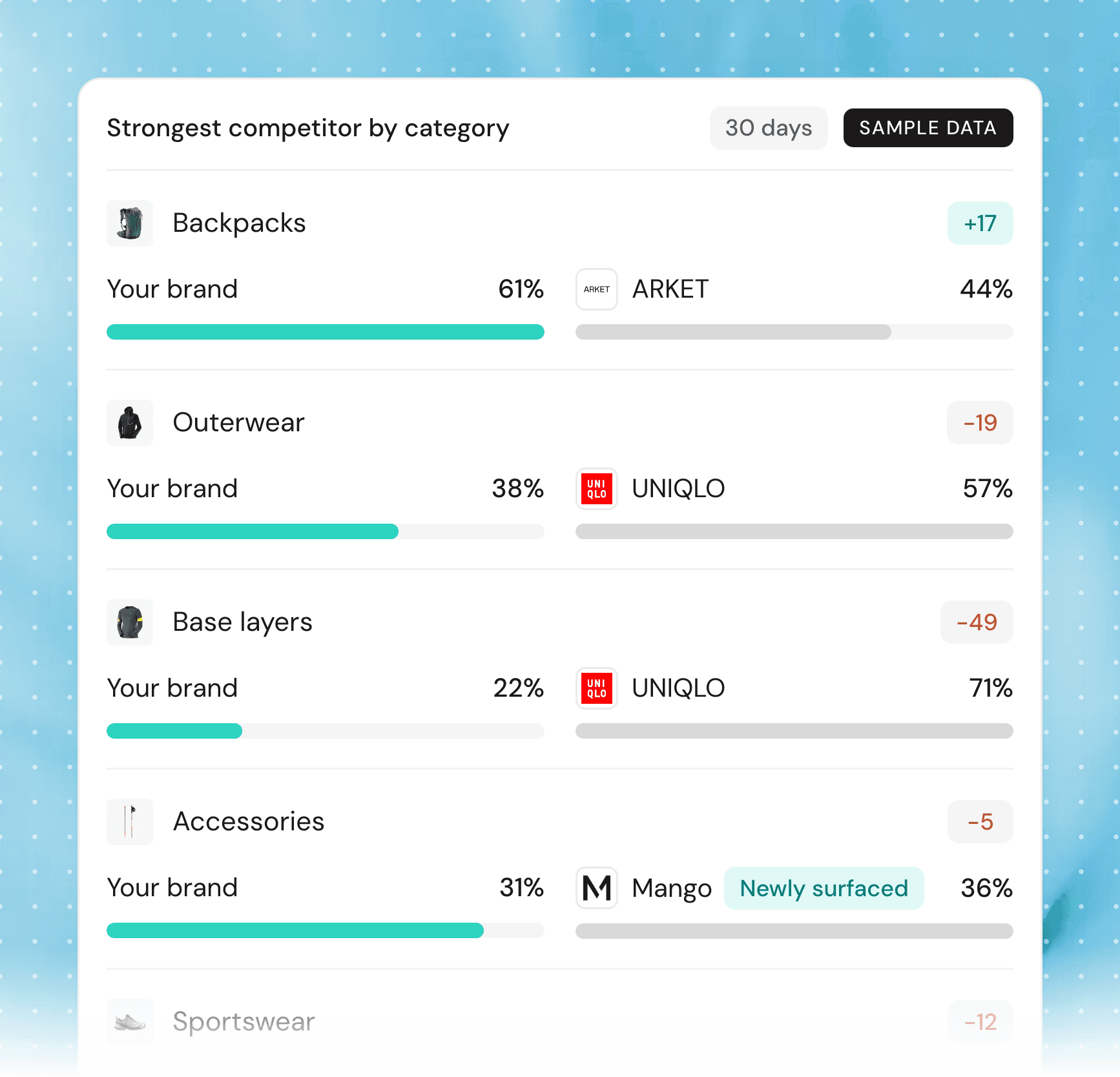
For every category, your visibility next to the strongest competitor in it. Not an average of everyone, the brand actually setting the bar.
COMPETITORS
The brands on your list are not always the ones taking your answers.
Knowing you are behind is one thing. Knowing which brand took the answer, and in which category, is what tells you where to start.
Direct and indirect, kept apart.
Direct competitors are the brands on the same shelf answering the same questions. Indirect are the category benchmarks you watch for context. Separating them stops a market leader's numbers drowning out the brand actually costing you sales.
Brands you did not know to track.
Glara surfaces the names that keep appearing alongside yours. Some of them are not competitors at all, and that is its own finding.
Compared against the best in each category.
For every category, your visibility next to the strongest competitor in it. Not an average of everyone, the brand actually setting the bar.
COMPETITORS
The brands on your list are not always the ones taking your answers.
Knowing you are behind is one thing. Knowing which brand took the answer, and in which category, is what tells you where to start.
Direct and indirect, kept apart.
Direct competitors are the brands on the same shelf answering the same questions. Indirect are the category benchmarks you watch for context. Separating them stops a market leader's numbers drowning out the brand actually costing you sales.
Brands you did not know to track.
Glara surfaces the names that keep appearing alongside yours. Some of them are not competitors at all, and that is its own finding.
Compared against the best in each category.
For every category, your visibility next to the strongest competitor in it. Not an average of everyone, the brand actually setting the bar.
ATTRIBUTES
AI is building a vocabulary around your brand whether you know it or not.
When AI recommends a product it adds attributes nobody asked for. Waterproof. Lightweight. Dermatologist tested. This is the most direct list you will get of what your content needs to say.
What they get credited for, and you do not.
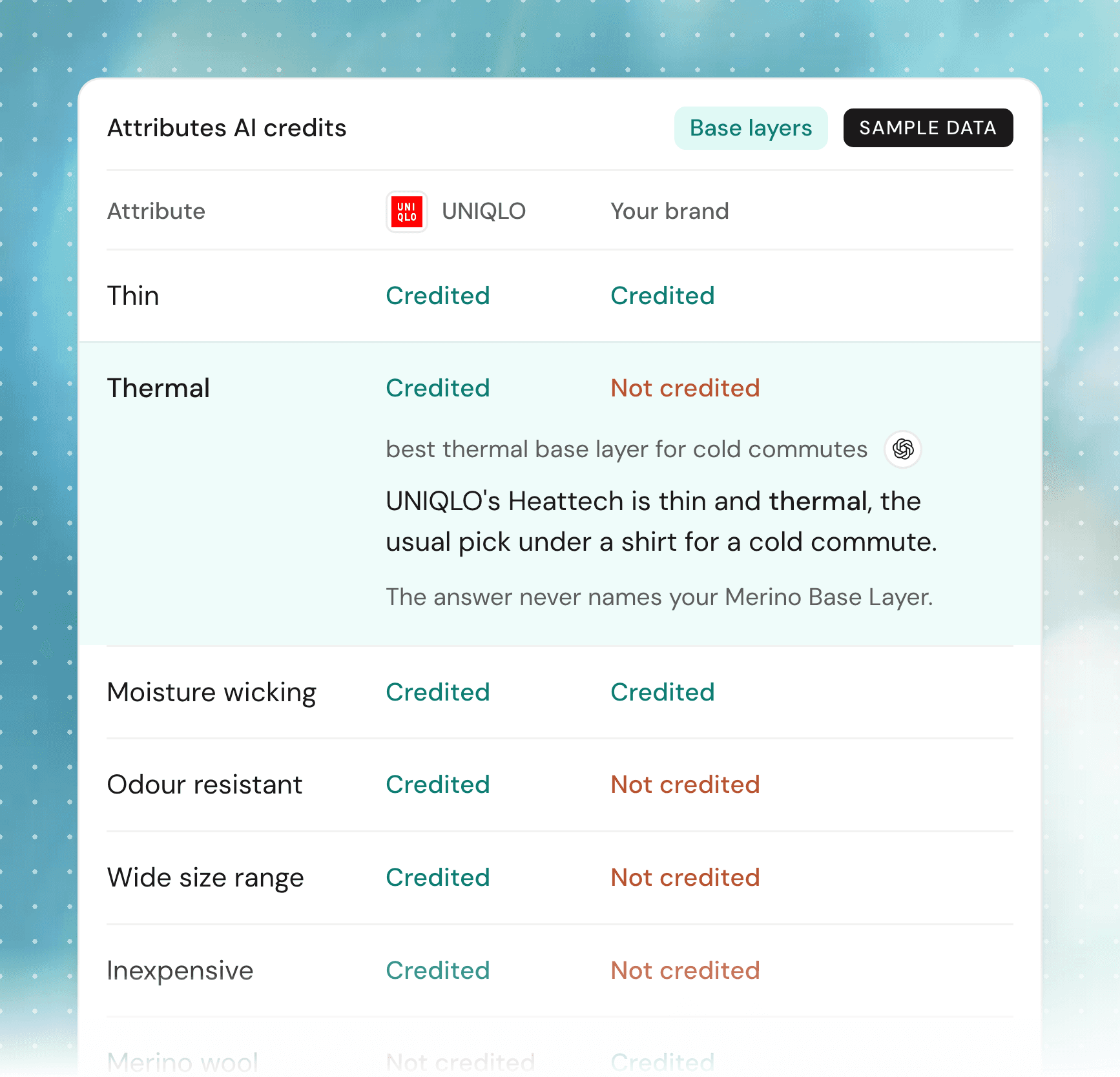
Every attribute AI attaches to a competitor in your category, next to the ones it attaches to you. The gaps are the brief.
Open it and read the answers.
Every attribute opens into the actual AI answers behind it, so you can see which questions it came up in and what was being discussed when a competitor got credited for it. An attribute on its own is a word. In context, it shows you the topic you are losing.
What it says about you that is not true.
Sometimes AI credits you with something you do not offer, or describes a product in a way you would not. Seeing it is the point. More often than not, the answer is somewhere on your own site.
A list, not a dashboard.
Attribute gaps are the same input the Optimizations Agent and Editorial briefs work from, so what you find here feeds directly into the work rather than becoming another chart to look at.
ATTRIBUTES
AI is building a vocabulary around your brand whether you know it or not.
When AI recommends a product it adds attributes nobody asked for. Waterproof. Lightweight. Dermatologist tested. This is the most direct list you will get of what your content needs to say.
What they get credited for, and you do not.
Every attribute AI attaches to a competitor in your category, next to the ones it attaches to you. The gaps are the brief.
Open it and read the answers.
Every attribute opens into the actual AI answers behind it, so you can see which questions it came up in and what was being discussed when a competitor got credited for it. An attribute on its own is a word. In context, it shows you the topic you are losing.
What it says about you that is not true.
Sometimes AI credits you with something you do not offer, or describes a product in a way you would not. Seeing it is the point. More often than not, the answer is somewhere on your own site.
A list, not a dashboard.
Attribute gaps are the same input the Optimizations Agent and Editorial briefs work from, so what you find here feeds directly into the work rather than becoming another chart to look at.
ATTRIBUTES
AI is building a vocabulary around your brand whether you know it or not.
When AI recommends a product it adds attributes nobody asked for. Waterproof. Lightweight. Dermatologist tested. This is the most direct list you will get of what your content needs to say.
What they get credited for, and you do not.
Every attribute AI attaches to a competitor in your category, next to the ones it attaches to you. The gaps are the brief.
Open it and read the answers.
Every attribute opens into the actual AI answers behind it, so you can see which questions it came up in and what was being discussed when a competitor got credited for it. An attribute on its own is a word. In context, it shows you the topic you are losing.
What it says about you that is not true.
Sometimes AI credits you with something you do not offer, or describes a product in a way you would not. Seeing it is the point. More often than not, the answer is somewhere on your own site.
A list, not a dashboard.
Attribute gaps are the same input the Optimizations Agent and Editorial briefs work from, so what you find here feeds directly into the work rather than becoming another chart to look at.
MONITOR
Score any product page for AI search, yours or theirs.
A weak competitor page is an opening. A competitor page that just got better is a warning.
Point it at any URL.
Any product page, yours or a competitor's, scored out of 100 across eight dimensions: answer-first content, on-page Q&A, use-case framing, structured data, metadata, reviews, key attributes and sizing. You get the score, what the page already does well, and a named list of what is missing.
Read it as a to-do list.
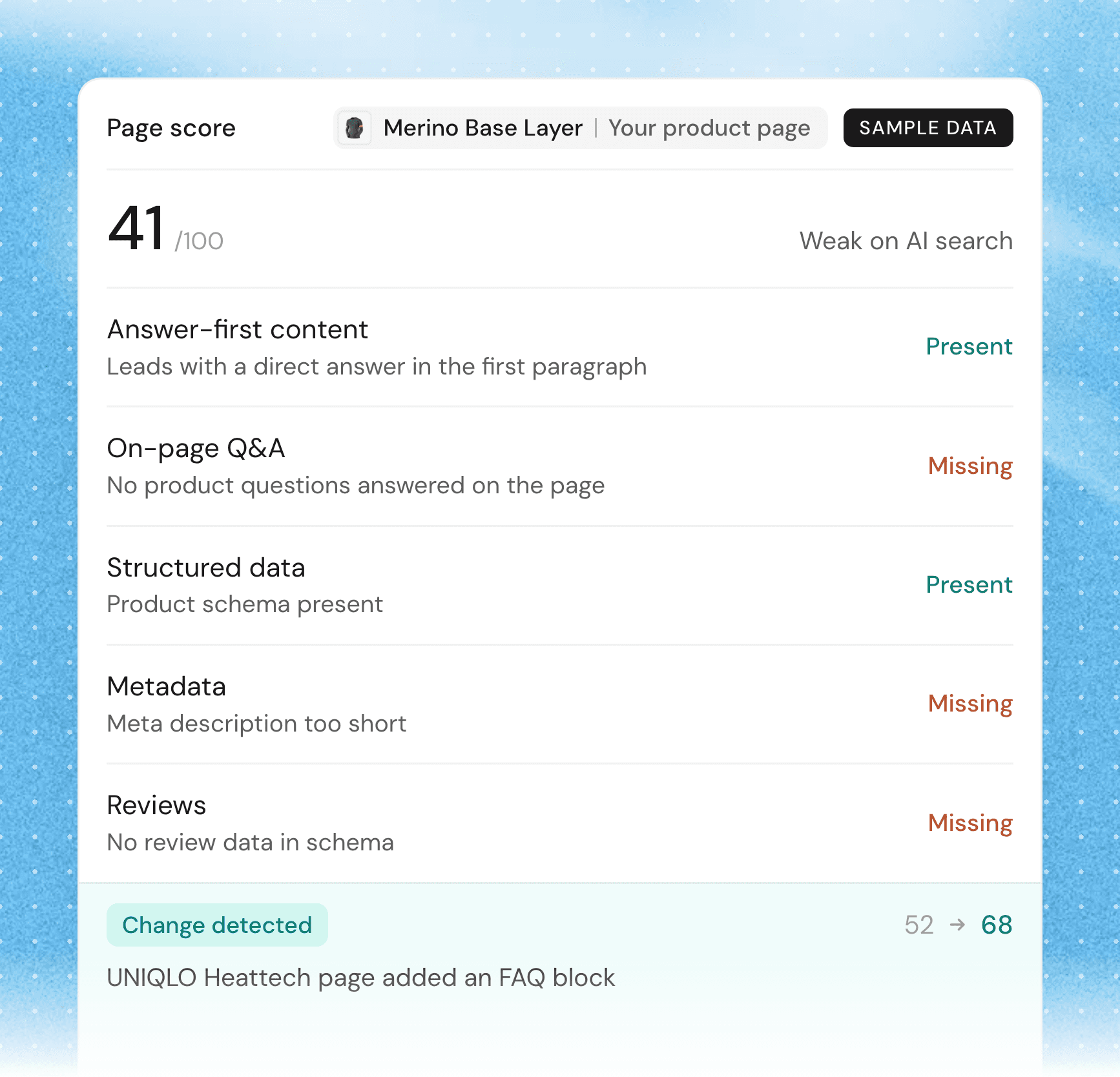
Every weakness comes back specific enough to act on. No on-page product Q&A. Meta description too short. No review data in schema. Missing use cases. Run it on your own page and you have a fix list. Run it on the competitor who keeps beating you and you can see exactly what their page has that yours does not.
Watch for movement.
Every change to a tracked page is flagged with what changed and how far the score moved. A competitor quietly adding an FAQ block or fixing their structured data becomes something you hear about, rather than something you work out from your own numbers three months later.
MONITOR
Score any product page for AI search, yours or theirs.
A weak competitor page is an opening. A competitor page that just got better is a warning.
Point it at any URL.
Any product page, yours or a competitor's, scored out of 100 across eight dimensions: answer-first content, on-page Q&A, use-case framing, structured data, metadata, reviews, key attributes and sizing. You get the score, what the page already does well, and a named list of what is missing.
Read it as a to-do list.
Every weakness comes back specific enough to act on. No on-page product Q&A. Meta description too short. No review data in schema. Missing use cases. Run it on your own page and you have a fix list. Run it on the competitor who keeps beating you and you can see exactly what their page has that yours does not.
Watch for movement.
Every change to a tracked page is flagged with what changed and how far the score moved. A competitor quietly adding an FAQ block or fixing their structured data becomes something you hear about, rather than something you work out from your own numbers three months later.
MONITOR
Score any product page for AI search, yours or theirs.
A weak competitor page is an opening. A competitor page that just got better is a warning.
Point it at any URL.
Any product page, yours or a competitor's, scored out of 100 across eight dimensions: answer-first content, on-page Q&A, use-case framing, structured data, metadata, reviews, key attributes and sizing. You get the score, what the page already does well, and a named list of what is missing.
Read it as a to-do list.
Every weakness comes back specific enough to act on. No on-page product Q&A. Meta description too short. No review data in schema. Missing use cases. Run it on your own page and you have a fix list. Run it on the competitor who keeps beating you and you can see exactly what their page has that yours does not.
Watch for movement.
Every change to a tracked page is flagged with what changed and how far the score moved. A competitor quietly adding an FAQ block or fixing their structured data becomes something you hear about, rather than something you work out from your own numbers three months later.
CONVERSATIONS
The threads AI is reading when it answers about your category.
Reddit posts, YouTube videos and Trustpilot reviews that AI models actually cited. Usually the ones where a competitor got recommended and your brand was never mentioned.
The threads that shaped the answer.
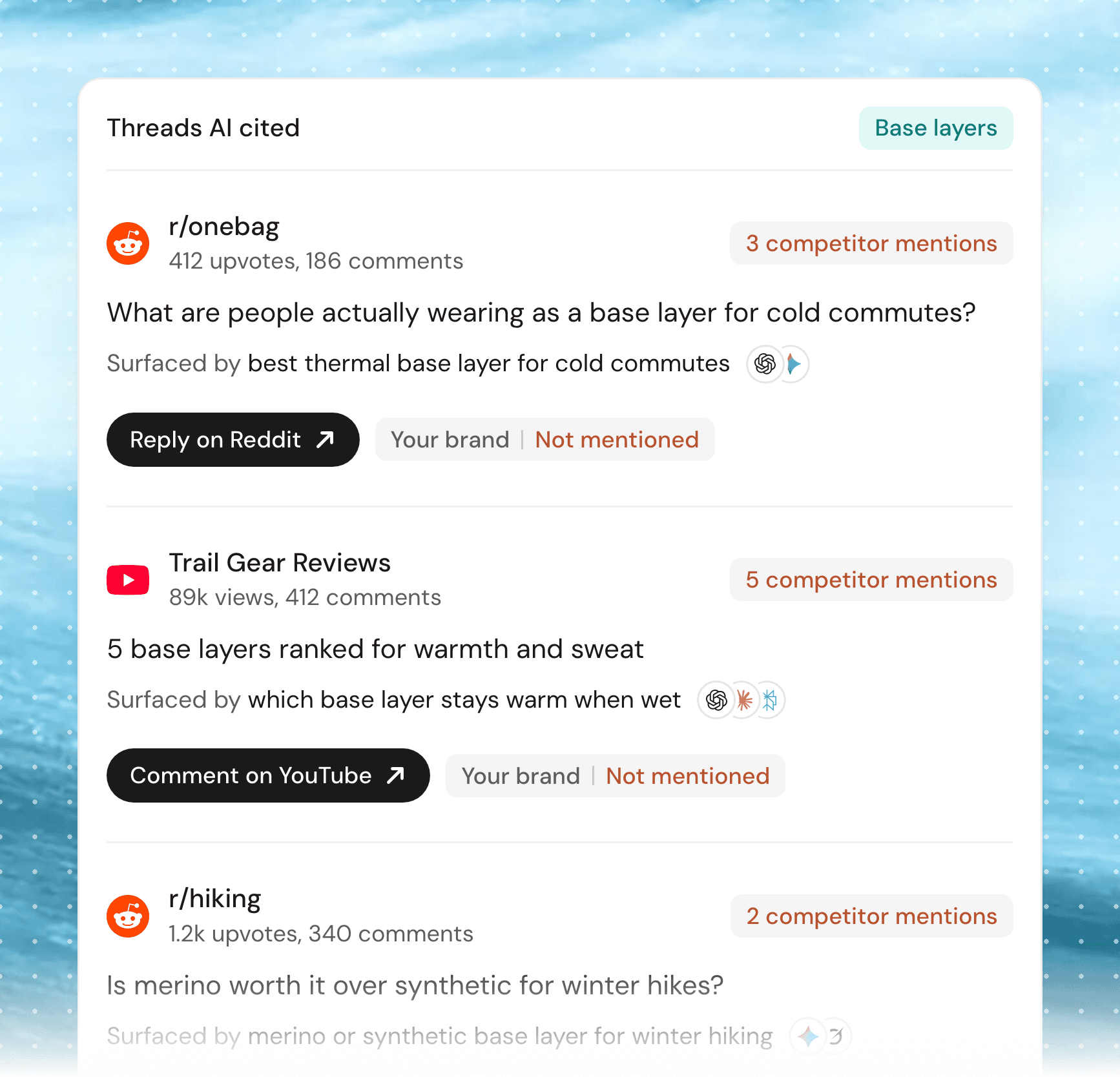
These are the community sources AI models used when answering questions in your category, each shown with the prompt that surfaced it and the competitors mentioned inside it.
Sorted by where you are missing.
Filter by how often competitors come up, or by how recent a thread is, to find the discussions where rivals are strong and you are absent. Unboxings, hauls and comparisons are the usual suspects.
Then go and take part.
Every thread links out so your PR, social or customer service team can join the conversation from your official account. Models retrieve these pages when they answer, so what your brand adds becomes part of what they read next.
CONVERSATIONS
The threads AI is reading when it answers about your category.
Reddit posts, YouTube videos and Trustpilot reviews that AI models actually cited. Usually the ones where a competitor got recommended and your brand was never mentioned.
The threads that shaped the answer.
These are the community sources AI models used when answering questions in your category, each shown with the prompt that surfaced it and the competitors mentioned inside it.
Sorted by where you are missing.
Filter by how often competitors come up, or by how recent a thread is, to find the discussions where rivals are strong and you are absent. Unboxings, hauls and comparisons are the usual suspects.
Then go and take part.
Every thread links out so your PR, social or customer service team can join the conversation from your official account. Models retrieve these pages when they answer, so what your brand adds becomes part of what they read next.
CONVERSATIONS
The threads AI is reading when it answers about your category.
Reddit posts, YouTube videos and Trustpilot reviews that AI models actually cited. Usually the ones where a competitor got recommended and your brand was never mentioned.
The threads that shaped the answer.
These are the community sources AI models used when answering questions in your category, each shown with the prompt that surfaced it and the competitors mentioned inside it.
Sorted by where you are missing.
Filter by how often competitors come up, or by how recent a thread is, to find the discussions where rivals are strong and you are absent. Unboxings, hauls and comparisons are the usual suspects.
Then go and take part.
Every thread links out so your PR, social or customer service team can join the conversation from your official account. Models retrieve these pages when they answer, so what your brand adds becomes part of what they read next.
TRUSTED BY ECOMMERCE BRANDS
“Glara is a game-changer for ecommerce. It doesn't just highlight issues, it helps solve them automatically. The insights have given us visibility we simply didn't have before.”
Daniel Doogan
Digital Marketing Manager, iCandy World
“Glara is a game-changer for ecommerce. It doesn't just highlight issues, it helps solve them automatically. The insights have given us visibility we simply didn't have before.”
Daniel Doogan
Digital Marketing Manager, iCandy World
Frequently asked questions
Frequently asked questions
Then tell us and we will change the set. Glara starts from the competitors you confirm during setup, then adds brands that keep appearing alongside yours, with a human check before anything is added. If a brand keeps showing up that you do not compete with, that is worth knowing too. It means AI is putting you in the same conversation.
Because this measures the questions specific to your category and your market, not their overall size. A much larger brand can own questions that have nothing to do with what you sell and still lose the ones your buyers are asking.
Most brands hand it to whoever runs their official social or PR accounts, because engaging works best from a brand handle rather than a personal one. There is no single right answer, which is why Glara surfaces the threads and leaves the judgment on which ones to join with you.
Yes. Point Monitor at any URL, yours or theirs, and it will score the page and tell you when it changes.
Not directly. Nobody can edit an AI model's view of a brand. What you can do is see it, find where it came from, and change what your own site says. That is usually enough over time.

See what your competitors are being credited for.
Get a free report showing which brands are taking the answers in your category, and what AI credits them for that it does not credit you.
See what your competitors are being credited for.
Get a free report showing which brands are taking the answers in your category, and what AI credits them for that it does not credit you.
Ecommerce leaders track and grow their AI revenue with Glara.
PLATFORM
© 2026 Glara. All rights reserved.
Ecommerce leaders track and grow their AI revenue with Glara.
PLATFORM
© 2026 Glara. All rights reserved.
Ecommerce leaders track and grow their AI revenue with Glara.
PLATFORM
© 2026 Glara. All rights reserved.